Showing posts with label Indians. Show all posts

19 May 2013

Book Review: Smart Phones Dumb People? - Parthajeet Sarma


People are getting dumber while phones are getting smarter. It’s a known fact. A funny saying these days goes such – “It’s important for man to be honest. Even phones are smart these days.” I had blogged about this here. The author, Parthajeet Sarma, looks to address this notion. Or so it seems by the title of the book – Smart Phones Dumb People?

Parthajeet Sarma is a fan of free markets and technology. This is evident from what he writes about. The author has slotted his thoughts into 5 main categories:

  • Technology
  • Innovation
  • Entrepreneurship
  • Priorities
  • Corruption

The author’s writing seems inspired by Gurcharan Das and the likes. He presents a holistic view of India and its citizens in each chapter and provides relevant examples to justify his view points. He reminds us of how lucky we are because mobiles phones and vehicles are affordable today viz-a-viz 2 decades ago. He focuses on how technology is being leveraged to make common man’s life easier. Examples include travel portals, e-commerce websites, banking and ATMs (which he predicts may turn mobile soon) and more. He laments over the attitude of students joining IIT (simply to adhere to society’s or their parents’ norms); how Facebook has reduced the amount we interact with real friends. He does this in anecdotal ways – some funny Facebook updates and incidents between his friends and him.
Smart Phones Dumb People?

Parthajeet Sarma believes innovation occurs mostly in the west and not in India. I would beg to differ. Jugaad Innovation points out how innovation is increasingly gaining speed in emerging nations (including India). The western world spends millions of dollars on innovation and invention with precious little gained from it. On the other hand, Indians invest lesser money and achieve results to address issues plaguing their people more effectively. Resource usage is optimized in India and other emerging nations more than in western countries today.

While the author talks about using 21st century tools to address 19th century issues, I wish he would focus more on how smart phones are hampering productivity of man today. He could have touched upon more aspects relevant to the title of the book. While some humans have used technology for the enhancement of society, most of us are distracted by it. E-mails, chats, Social media and more keep us so distracted that we refuse to spend even a few minutes by ourselves. In fact, someone I know wants m-indicator, an app which suggests train and bus timings in Mumbai, to start suggesting which trains we should catch to reach work on time. Our increasing dependence on technology is scary. The book can also do with more concise writing. We Indians are guilty of framing long sentences; trying to put too many points in one sentence. That, however, adversely impacts the attention span of the reader. I’m sure, with time, Parthajeet Sarma will become more adept at writing (or he’ll find a better ghost writer ;) ).

The book is a breezy read; one that can be finished in a few hours. It doesn’t beat around the bush. Instead, it briskly covers a lot of points. ‘Smart Phones Dumb People?’ is a good read for youngsters who would like a bird’s eye view of how India has progressed over the ages. However, voracious readers may find it a little wanting in language. I wish Parthajeet Sarma all the best and hopes he keeps coming out with better books.

7 Jun 2012

An Interaction with Vodafone Customer Service Raises Other Questions...

My first customer service interaction with Vodafone got me thinking - "Where does India stand when it comes to Customer Service? Further, where do we stand while solving problems for those not personally related to us?"

Vodafone Service?
I bought a voucher from Vodafone (the one of bonus SMSes), which had a distorted code when I scratched it. I called Customer Service who told me to visit the vendor. When I did, the vendor said the process had changed. I had to visit a Vodafone Store. That was delay no. 1. I visited a Vodafone Store, where the rep, Laxman, asked me 100 details before telling me it would take 48 hours for Vodafone to put the SMS pack onto my account. No amount of discussion with him helped, so I walked out and thought I’d try elsewhere. This was delay no. 2. I was en route to meeting a friend in Dombivli, where I sawa another Vodafone service centre. I decided to try my luck there. They took my details and told me the same thing – 48 hours. I tried to reason with them, saying I didn’t make them wait 48 hours for payment when I bought a voucher from them; that I would lose money (1 buck per SMS) for those 2 days. I expected some empathy; instead I got apathy. The manager at Dombivli, Haridas, even went to the extent of saying it was my fault the voucher was screwed. He made it sound like he was doing me a favour by going through the process; a process which was more harmful to me than useful. In the end, exasperated, I gave in and walked away. Living up to their reputation, Vodafone recharged my account in – DRUMROLLS PLEASE – 72 HOURS! This drove the final nail in the coffin.

What if the customer involved was someone who couldn’t afford the amount lost over the next 3 days? I’ve worked for an international telecom organization, where we had the option of adding some credit, SMSes, etc. to make life easier for customers when such system generated issues occurred. Can’t the same thing be done in India? When it comes to providing Customer Service here, we often take a beating.

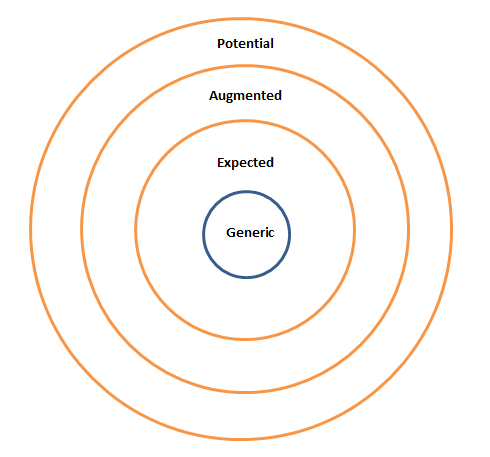
The Expected circle includes what an organization is expected to offer, while the augmented circle includes features/aspects which go beyond expected offers. When an organization blends aspects from the augmented circle into the expected one, it will achieve success and leapfrog competition.
Whole Product Circles

The same applies to Customer Service (CS). When CS goes beyond what a customer expects Brand Equity and credibility improve exponentially. That’s one reason we’re losing the BPO business to Philippines. They focus more on customer satisfaction and finding alternate methods to help, which enhances the customer experience with the brand. We, on the other hand, are still stuck with the concept of... you guessed it... PROCESS!

The PROCESS said I must wait 2 days (actually 3) for a recharge I had paid for; PROCESS says a car cannot be repaired urgently in a workshop though the reason may be genuine; PROCESS is what hurts most of us even in the corporate world. Being accommodating seems to disappear when we have to give; it appears when we want. Giving me 10 free SMSes would’ve cost Vodafone barely anything (10 SMSes x 10 p/SMS = Re. 1). In trying to save that 1 rupee, they’ve lost out on lots of good publicity they could’ve received through customers like us, which is priceless.

My professor told us about a rule in Wal-Mart where anything can be replaced/refunded in 8 days! No questions asked. However, most people who take undue advantage of this rule in USA are Indians. They use something purchased from Wal-Mart and return it in less than 8 days saying they don’t need it. My professor wanted to have a razor blade exchanged he had purchased in Manhattan when he went there again. He had no bill or service number, etc. The rep simply told him it was a defunct piece, no longer in production and replaced it with the latest model. No questions asked, no answers given! On the other hand, when he tried to use the warranty option at CROMA for an article he purchased, he was made to run around so much that he let it go.
 
VODAFONE and other Indian brands, are you listening?
badge UA-22264662-1