Showing posts with label entrepreneur. Show all posts

19 May 2013

Book Review: Smart Phones Dumb People? - Parthajeet Sarma


People are getting dumber while phones are getting smarter. It’s a known fact. A funny saying these days goes such – “It’s important for man to be honest. Even phones are smart these days.” I had blogged about this here. The author, Parthajeet Sarma, looks to address this notion. Or so it seems by the title of the book – Smart Phones Dumb People?

Parthajeet Sarma is a fan of free markets and technology. This is evident from what he writes about. The author has slotted his thoughts into 5 main categories:

  • Technology
  • Innovation
  • Entrepreneurship
  • Priorities
  • Corruption

The author’s writing seems inspired by Gurcharan Das and the likes. He presents a holistic view of India and its citizens in each chapter and provides relevant examples to justify his view points. He reminds us of how lucky we are because mobiles phones and vehicles are affordable today viz-a-viz 2 decades ago. He focuses on how technology is being leveraged to make common man’s life easier. Examples include travel portals, e-commerce websites, banking and ATMs (which he predicts may turn mobile soon) and more. He laments over the attitude of students joining IIT (simply to adhere to society’s or their parents’ norms); how Facebook has reduced the amount we interact with real friends. He does this in anecdotal ways – some funny Facebook updates and incidents between his friends and him.
Smart Phones Dumb People?

Parthajeet Sarma believes innovation occurs mostly in the west and not in India. I would beg to differ. Jugaad Innovation points out how innovation is increasingly gaining speed in emerging nations (including India). The western world spends millions of dollars on innovation and invention with precious little gained from it. On the other hand, Indians invest lesser money and achieve results to address issues plaguing their people more effectively. Resource usage is optimized in India and other emerging nations more than in western countries today.

While the author talks about using 21st century tools to address 19th century issues, I wish he would focus more on how smart phones are hampering productivity of man today. He could have touched upon more aspects relevant to the title of the book. While some humans have used technology for the enhancement of society, most of us are distracted by it. E-mails, chats, Social media and more keep us so distracted that we refuse to spend even a few minutes by ourselves. In fact, someone I know wants m-indicator, an app which suggests train and bus timings in Mumbai, to start suggesting which trains we should catch to reach work on time. Our increasing dependence on technology is scary. The book can also do with more concise writing. We Indians are guilty of framing long sentences; trying to put too many points in one sentence. That, however, adversely impacts the attention span of the reader. I’m sure, with time, Parthajeet Sarma will become more adept at writing (or he’ll find a better ghost writer ;) ).

The book is a breezy read; one that can be finished in a few hours. It doesn’t beat around the bush. Instead, it briskly covers a lot of points. ‘Smart Phones Dumb People?’ is a good read for youngsters who would like a bird’s eye view of how India has progressed over the ages. However, voracious readers may find it a little wanting in language. I wish Parthajeet Sarma all the best and hopes he keeps coming out with better books.

20 Dec 2012

Book Review - Jugaad Innovation


“An innovative fix; an improvised solution born out of ingenuity and cleverness.”

That’s how authors Navi Radjou, Jaideep Prabhu and Simone Ahuja define Jugaad. While we Indians generally associate the term with a negative feel, the trio give it a much more holistic definition in their book ‘Jugaad Innovation’. The Economist states that this is the most comprehensive book to appear on the subject. Is it true? Well, you have to read it to find out.

The book sets off in Ramakrishna Nagar, a village in the desert of Gujarat, where a potter Mansukh Prajapati turned into an entrepreneur a few years ago. He designed and developed Mitticool, his version of a fridge. It’s a terracotta box entirely made of clay, except for a glass door and plastic tray at the bottom. Water from an upper chamber seeps through the side walls, cooling the lower food chamber through evaporation. The fridge consumes zero electricity, produces no waste, is completely biodegradable and costs merely 2000 bucks. Witchcraft, right?
Jugaad Innovation

There are other ingenious designs and business models across emerging nations cited in this book, which make it a pleasure to read. The concept of Jugaad, the authors say, is not restricted to India. The Brazilians call it jeitinho; the Chinese have their own term for it: zizhu chuangxin while the Kenyans term it jua kali. Gustavo Grobocopatel from Argentina, unhindered by scarcity of resources and funds, launched his company Los Grobo which is now the 2nd largest grain producer in the country thanks to Jugaad. Tulsi Tanti from Gujarat, faced with infrastructural bottlenecks while setting up a textile company, founded Suzlon Wind, the world’s 5th largest wind energy solutions provider. It examines business models of YES Bank & Future Group (the founders of Big Bazaar) and tells us why and how those unconventional models succeeded in India. This book is laden with many more such examples.

Research states that a whopping $550 billion (about 60% of the total borrowing by the Indian government in 2011!) was spent by western countries on R&D in 2010. Organizations’ constant desire to over engineer and structure an innovation process does them more harm than good. That’s probably why we witness many western firms filing for bankruptcy.

Hence, the authors explain that corporate entities can (and must) incorporate Jugaad to encourage innovation if they want to survive cut throat competition. They enlist 6 principles of Jugaad entrepreneurs, which are:

·        Seek opportunities in adversity
·        Do more with less
·        Think and act flexibly
·        Keep it simple
·        Include the margin
·        Follow your heart

These principles are elaborated upon in form of 6 chapters very well; each chapter also has lessons on how the corporate sector can use the respective principles to innovate. The book inspires not only corporate leaders, but also normal people like us to develop resilience, passion, flexibility, frugality, simplicity and empathy so that we can contribute to society. A foreword by Ratan Tata and an introduction by Sam Pitroda (who pioneered the telecom revolution in India) only add to its credibility. A good entrepreneur is one who can feed 1000 families, directly and indirectly. Let’s try and make ourselves capable of feeding even ½ that number. And the only way to do it is through Jugaad. Jugaad Innovation is a must read for everyone, whether we want to be entrepreneurs or not. It will make you exercise your mind and come up with ideas of small innovations which can make even your daily lives easier.

24 Mar 2012

Book Review - Chicken Soup for the Indian Soul At Work

“There is no traffic on the last mile.” – Prashant Jaiswal.

This is one line that sums up what ‘Chicken Soup for the Indian Soul at Work’ is all about. Stories of people (Indians) who have made it through tough times at work; who have been in circumstances when all seem lost but came out on top; who have not known what giving up is however hopeless the situation. These people made work their lives rather than harping on the work life balance.

The book has been jointly authored by Juhi Rai Farmania (who has also narrated some stories of her own), Jack Canfield and Mark Victor Hansen. Juhi Rai Farmania is a networker building an e – commerce platform in India and UK. She is fond of e – commerce sites, something she confesses in one of her stories. Jack Canfield and Mark Victor Hansen are #1 New York Times bestselling co – authors, professional speakers who have dedicated their lives to enhancing others personally and professionally. The stories and narrations in this book are aimed at doing just that.
Chicken Soup for the Indian Soul At Work

The book is divided into 13 sections which are:
·        From the CEO’s desk
·        Turning obstacles into opportunities
·        Changing Roles and Industries
·        Leading & Mentoring
·        Balancing personal and professional lives
·        Self – made and successful
·        On lessons learned
·        Humour and fun at work
·        Extraordinary entrepreneurs
·        Persistence and courage
·        Listening to the head and the heart
·        Business – The Hindustani way
·        A message for those starting out.

The end of the book also includes more about Chicken Soup and the contributors. Some of the authors are renowned corporate entities like Dr. Kiran Majumdar Shaw (Chairperson and MD of Biocon), Chitrangada Singh, Beerud Sheth (co – founder of SMS GupShup), the HR Head of Phillips India and others. The stories are heart rending and show us how much trouble some people have gone through to reach their existent position in society and life. The HR Head of Phillips narrates how he went to office one night to sort a union issue whilst his wife was on her deathbed. Mita Banerjee writes how Manjriben’s life fell apart when her husband’s shop was destroyed but she turned her fortunes around. The Leadership & Mentoring section has lovely stories on understanding bosses, whether their juniors were stuck in a traffic jam when it was time for an important presentation, or when the latter got emotionally carried away during a project. Extraordinary Entrepreneurs relates short stories of people who found an opportunity to plug some gap. As Richard Branson rightly says “Entrepreneurship is like a bus ride. There’s always another one coming.” The most touching story is about a Dad whose sun truly believes his dad knows everything, but is really busy. So when the son is asked what his Dad’s profession is, he writes ‘busyness’. When his dad reads the article, he understands he’s been neglecting his son.

On the flipside, the book could have done with better writing. There are many words which could be avoided, sentences which could be shortened and stories which could be reduced in length. That’s one of the 2 problems with us Indian writers; we use too many unnecessary words in our articles, write ups, etc. The other one is the excessive use of ‘I’. Too many stories are ‘I’ centric, something that successful people would desist from. Plus, some stories could be avoided as they don’t pack a big punch; not sure if they’re good enough to feature in a book on work life.

Overall, however, the book is a good read. A pleasant pastime and one that makes us understand how difficult life actually is for some people. But those people have come up trumps against all odds. This book makes a good read for those who have a job, run a business or a looking to start either. Thanks, Blogadda, for providing me with the opportunity to read and review this book.

This review is a part of the Book Reviews Program at  Blogadda.com. Participate now to get free books!

22 Jan 2012

The Best Thing In Life Is...

FREE! Yes, the best thing in life is FREE! Your family! The family that brings you into this world, nurtures and nourishes you, teaches you values which steer your life, stands you up on your feet and then supports you for the rest of your life. This family includes your parents, grandparents, wife and maybe children.

But there is a price we pay for sustaining this family and maintaining its strength; the price of sacrifice, hard work, time, thought and effort. It’s a price we all gladly pay. Every individual has to do her/his bit to ensure the family functions smoothly (I know ‘functions’ sounds a little crude word, but you get the idea, right?). True, there are bad times, but as we have to remember what William Shakespeare says – “This, too, shall pass!”

Today’s manic world demands a lot of our time. So much time that we spend a lot more time with friends, colleagues, work buddies, etc. than with our families. I had talked here about how we youngsters have started focussing more on materialistic things. Technology, elite goods, fast food, movies, trash TV programmes, etc. now take up a lot of our time which we otherwise could have spent with family. More time spent with work colleagues than with a significant other is one reason for the spurt in extra marital affairs. We’re gradually being pulled away from our roots and being plunged into the culture followed in the West, something we prided on avoiding earlier.
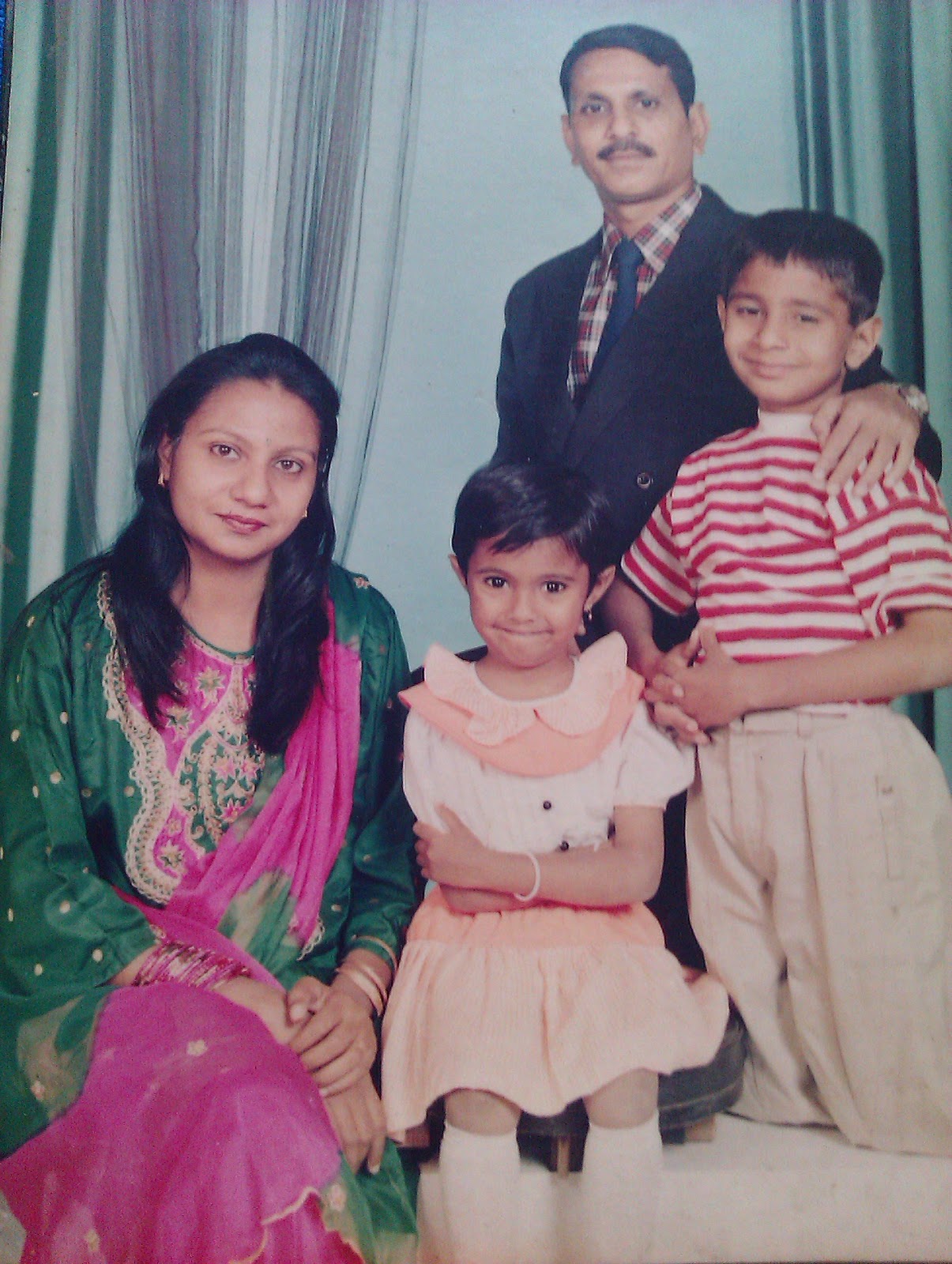
File photo of my family some 2 decades ago

7 Jan 2012

The TeS2011 Experience... An Entrepreneurial Summit...

I had attended the TiE Entrepreneurial Summit (TeS2011) at Bangalore on 15th & 16th December, 2011. I know it’s almost a month since the event was held, but there are some insightful points I want to share with you.

The Indus Entrepreneurs (TiE) is a community which was initiated by a handful of successful entrepreneurs almost 20 years ago; the most noted name of those being Vinod Khosla. Today TiE exists in 57 cities, 14 countries and spans across 5 continents.

A lot of accomplished and prolific entrepreneurs had come as speakers. They shared their knowledge and experiences with budding and wannabe starters. Some of those speakers were Dr. N.S. Raghavan (Founder Infosys & NSRCL), Sachin Bansal (Flipkart.com), Kunal Bahl (Snapdeals.com), Hari Rajagopalachari (PwC) and Dr. G. Sridhar (ACE Learning). Lunch, dinner and tea sessions provided good opportunities for attendees to connect with each other.

I’ll quote some insightful and interesting points shared by a few of them:

a.   Perception of unfairness in an organization (and real life) can be mitigated by increasing transparency & communication.
b.     Humans are filled with ‘Unrealistic Optimism/bias’, i.e. the hope that things will get better, about many situations in life despite credible information and data to oppose the belief.
c.  Behavioural economics & neuroeconomics (subjects that highly interest him) are already playing a key role in businesses pricing and positioning their products & services.

a.      USA has witnessed 47 recessions in its 220 year history. All cases have extended into global crises.
b.      In 2011, India has had a $15 billion trade surplus with the US. Also, in this year, the US has exported goods & services worth $1.4 trillion but imported worth $1.8 trillion. (This goes to show how difficult it is for US to control the fiscal deficit and borrowing, which is already 120% of the $14 trillion GDP).

a.      The fundamentals of e – commerce in India are strong.
b.      Selection of products is the largest property of an e – com organization.
c.      Talent, infrastructure and payment methods, amongst others, are the biggest challenges for an e – com service in India today.

a.      The 3 key pillars of an e – commerce company are – Value, Assortment & convenience.
b.      In 2 years, around 3, 00,000 online transactions (purchases) are expected to occur in India daily.
c.     Tier I cities prefer online retail for convenience & choice, while Tier II do so due to lack of options in offline retail.

badge UA-22264662-1