Showing posts with label Gurcharan Das. Show all posts

24 Oct 2014

Which Will Be the Fastest Growing Country in the Coming Decade?

“The old forecasting rule was to make as many forecasts as possible and publicize the ones you got right. The new rule is to forecast so far into the future that no one will know if you got it wrong.” - Ruchir Sharma.

Which is the world’s fastest growing economy currently? Without doubt, it’s China. But will China continue on the path of 9-10% growth for the next few years? Most economists think it will, but China is slowing down due to multiple reasons. It may soon witness a recession, which won’t be anywhere close to what the rest of the world encountered in 2008. China’s recession is more like a slowdown to 6% growth.

So which country will bag the gold medal for growth in the coming decade? Ruchir Sharma attempts to answer this question through his masterpiece ‘Breakout Nations’. He has analyzed the history, political scenario and sentiment of a lot of emerging markets and correlated them to the countries’ economic conditions. In this book, renowned economist Ruchir Sharma meticulously dissects countries like India, Russia, Brazil, China, South Africa, South Korea, Mexico, Turkey and others. He offers valid insights, backed up with sound stats, into the strengths, weaknesses and areas of opportunities for these emerging nations.  

'Breakout Nations' - Ruchir Sharma


Every nation has its fair share of obstacles. Whether it’s infrastructure, government overspending, policy paralysis, the refusal of political figures to give up power, stagnation or something else, each country is battling problems which have occurred due to decades of following the same patterns. Some countries like Russia, Brazil, Nigeria and South Korea have used difficult times to revamp the way they functioned, and have been rewarded handsomely. Others have chosen to stick to tried and tested (and purely functional) models which have restricted their opportunities for growth.

Ruchir Sharma isn’t just shooting from the hip like many so-called economists do.  He has toured each country extensively. He brings out astonishing details of day-to-day functioning the emerging nations. For instance, the strategy being adopted by companies in China to woo workers back from their villages after Christmas vacations. Or corporate head honchos in Brazil using helicopters to travel from one office to another within the city because of excessive traffic. Or that Russia is heavily dependent on oil prices to secure its future. Each problem (and more) has stemmed from conditions which have been building over long, and continue develop. Since this book was written in 2011, scenarios have changed a little. But most of his predictions seem on track for the coming decade.


This book is a pleasant and entertaining read for anyone who is remotely interested in economics. The language is simple yet elegant. Facts are made interesting with the help of short stories and anecdotes. It reminds me so much of Gurcharan Das’ ‘India Unbound’, another gem. Of course, after having spent years interacting with the world’s most powerful politicians and writing umpteen research papers, nothing less is expected of Ruchir Sharma. I couldn’t find a single shortcoming in the book. Partly because of my love for macro economics and also because I don’t have even 0.1% of the knowledge which the author has. Read the book to find out which are the ‘Breakout Nations’ according to the author. You will be surprised to know that they’re from among the usual suspects.

6 Aug 2014

Newspapers Are the Cause for Rise in Crime

Gangrapes, child molestations, extortion and blackmail, accidents, deaths, divorces... newspapers are filled with these reports. And they should be. We should be aware of the latest happenings around us. And it’s the duty of newspapers to report these incidents, right?

Well, my theory is that newspapers are the reason these crimes are on the rise. Now that’s a paradox. Aren’t newspapers the reason these crimes are reported and can be controlled? Well, not really.

Man is a product of the 5 people he spends most time with, and what he reads. And today, man barely has time to read anything other than newspapers. Maybe a Chetan Bhagat novel here and there. What does he read in newspapers? Rampant incidents of rapes, child abuse, domestic violence, death, bribery, corruption and more. Since papers barely report the punishment meted out to such criminals, they appear to have gotten away with it. Maybe he can too. If he can’t the newspapers will carry his name, won’t they? They will glorify him. He will be a hero; brag to his friends; his colony will celebrate his name – doesn’t matter why. In short, these bloody newspapers indirectly encourage criminal minds. Why do they continue to report these cases? Because they’re paid by politicians and rich businessmen to keep actual news like ineffective policies, corruption and dying farmers under wraps. Don’t believe me? Look for the e-newspaper article of Ambani’s son crashing his car into 2 others one night. After all, why won’t we vote for politicians just because molestation cases are on the rise? We will protest a little (get our names and faces in the papers), turn apathetic in some time and go back to our depressing lives again.

Gurcharan Das had written in ‘India Grows At Night’ that during the internal war in Egypt, a leading Egyptian newspaper carried the photo and an article on an old man planting a nursery. This was a symbol of hope, of positivity. Numerous websites and posts on social networking sites carry stories of humanity, inspiration and love. Why can’t newspapers do the same? Well, it’s because they’re just trying to sell. And they know that this ‘inspiration, motivation and hope’ shit doesn’t sell for long. We humans crave for tragic stories; we yearn to feel subconsciously satisfied at the fact that other people are worse off than us.

I have stopped reading Times of India and Indian Express since some time now. I just breeze through it because I’m still a sucker for stories which offer hope. Unfortunately, I find none. Time for you to open your eyes and mind. Stop lapping up these crappy stories in newspapers and watch crime rates dwindle. Or maybe newspapers will start reporting the punishment dished out to these criminals too. Change will be slow, it will be gradual, but it will come.

19 May 2013

Book Review: Smart Phones Dumb People? - Parthajeet Sarma


People are getting dumber while phones are getting smarter. It’s a known fact. A funny saying these days goes such – “It’s important for man to be honest. Even phones are smart these days.” I had blogged about this here. The author, Parthajeet Sarma, looks to address this notion. Or so it seems by the title of the book – Smart Phones Dumb People?

Parthajeet Sarma is a fan of free markets and technology. This is evident from what he writes about. The author has slotted his thoughts into 5 main categories:

  • Technology
  • Innovation
  • Entrepreneurship
  • Priorities
  • Corruption

The author’s writing seems inspired by Gurcharan Das and the likes. He presents a holistic view of India and its citizens in each chapter and provides relevant examples to justify his view points. He reminds us of how lucky we are because mobiles phones and vehicles are affordable today viz-a-viz 2 decades ago. He focuses on how technology is being leveraged to make common man’s life easier. Examples include travel portals, e-commerce websites, banking and ATMs (which he predicts may turn mobile soon) and more. He laments over the attitude of students joining IIT (simply to adhere to society’s or their parents’ norms); how Facebook has reduced the amount we interact with real friends. He does this in anecdotal ways – some funny Facebook updates and incidents between his friends and him.
Smart Phones Dumb People?

Parthajeet Sarma believes innovation occurs mostly in the west and not in India. I would beg to differ. Jugaad Innovation points out how innovation is increasingly gaining speed in emerging nations (including India). The western world spends millions of dollars on innovation and invention with precious little gained from it. On the other hand, Indians invest lesser money and achieve results to address issues plaguing their people more effectively. Resource usage is optimized in India and other emerging nations more than in western countries today.

While the author talks about using 21st century tools to address 19th century issues, I wish he would focus more on how smart phones are hampering productivity of man today. He could have touched upon more aspects relevant to the title of the book. While some humans have used technology for the enhancement of society, most of us are distracted by it. E-mails, chats, Social media and more keep us so distracted that we refuse to spend even a few minutes by ourselves. In fact, someone I know wants m-indicator, an app which suggests train and bus timings in Mumbai, to start suggesting which trains we should catch to reach work on time. Our increasing dependence on technology is scary. The book can also do with more concise writing. We Indians are guilty of framing long sentences; trying to put too many points in one sentence. That, however, adversely impacts the attention span of the reader. I’m sure, with time, Parthajeet Sarma will become more adept at writing (or he’ll find a better ghost writer ;) ).

The book is a breezy read; one that can be finished in a few hours. It doesn’t beat around the bush. Instead, it briskly covers a lot of points. ‘Smart Phones Dumb People?’ is a good read for youngsters who would like a bird’s eye view of how India has progressed over the ages. However, voracious readers may find it a little wanting in language. I wish Parthajeet Sarma all the best and hopes he keeps coming out with better books.

17 Feb 2012

5 Awesome Books for Reading!

I’ve blanked out! I’m neglecting my blog! I’m woefully short of ideas & topics, feeling quite blue and appear to finally have HIT the phenomenon called ‘Writers’ Bloc’.

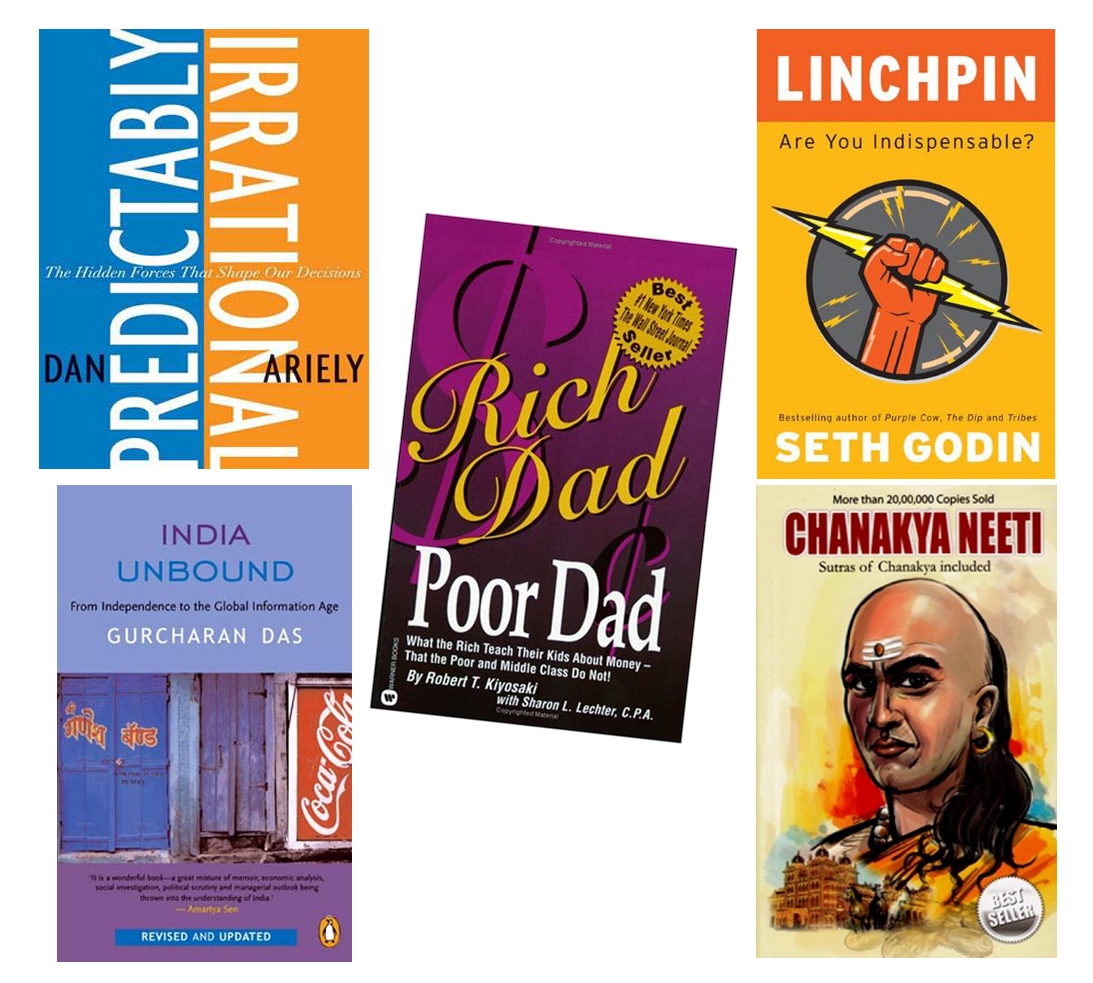
To keep my blog going, I’ve compiled a list of my 5 top favourite books. These books have pretty much moulded my thought patterns and outlook towards life (in & around me).

1.) India Unbound: Arguably the BEST book depicting the India story. The author, Gurcharan Das, analyzes India since the days of Alexander and brings us to speed with the current scenario. Historic, economic, political, social and cultural aspects are looked into to give us an in depth idea as to how India has developed through the ages. The New York Times sums it up best as "Something tremendous is happening in India, and Das, with his keen eye and often elegant prose, has his finger firmly on the pulse of the transformation.” Truly an amazing book which I can (and do) read over & over again.

2.) Predictably Irrational: This book shot author Dan Ariely to fame, and quite deservedly so! We humans are endowed with brains which differentiates us from animals. Hence, we must take rational decisions. However, we humans defy logic and take a lot of irrational decisions. That irrationality, however, has a pattern to it; that irrationality can be predicted! Dan Ariely shows us how through witty experiments and case studies. A must read for someone who wishes to understand human psychology better.
5 of my all time favourites. What about yours?

badge UA-22264662-1